“Nothing is more necessary than to speak of certain things whose existence is neither demonstrable nor probable.”, Herman Hesse

Image produced by Google Whisky
Science, by its very nature, is certain, or at least how we expect it should be! But philosophy is not; it includes thoughts, ideas, connections,… While we never use the word “philosophical fact”, facts are inevitable or even necessary in science. Yet, the world of science does not fully reflect our reality. Reality is a mystical concept that we make scientifically absolute by imposing certain boundaries and conditions on it, which by definition make the world of science. These boundaries change slightly from discipline to discipline, but every enquiry in science is generally categorized as theory or experiment. The most acceptable ideas, however, are those evidence/experimental based theories which become facts. By every experiment, however, we are reducing the world’s reality to a portion of reality for proving a concept or theory by which our imagination of that tiny reality was formed. Our picture of the world, therefore, is a puzzle-like picture with pieces coming from separate experiments. The more pieces we gather, the better resolution our picture will have, but we can’t produce a real picture of our world because it’s impossible to make one experiment for all disciplines at once! We try to do our best to improve our instruments, our scientific techniques, and to expand our interdisciplinary view of the world, only to have a better, more accurate picture of our reality. But, perhaps, this is where we got it wrong; the reality we try to define in a more certain, rigid way is not certain at all! Maybe it’s in the gap between theories and our designed experiments, that reality, the real one, fades away! Maybe we live in a wavy world with a smooth wave function that can’t be fully observed! This is by no means science fiction, or a depiction of a fantasy reality; This is the best picture, perhaps the most real one, that science could ever make of reality! That’s a picture of a quantum world.
“What we see when we look at the world seems to be fundamentally different from what it actually is!” This, by the word of a theoretical physicist*, is the enigma at the heart of quantum reality! Yet, this wavy picture of the world provided by quantum mechanics seems to be the closest to our reality compared to those offered by any other discipline. Its fundamentals are built upon uncertainty principles, but is it not actually the way reality works? Quantum mechanics puzzles us with the most amazing science story while making the real world around us upside down!
The whole world in quantum mechanics is defined by a smooth wave function. This wave function is the identity of every system. It includes all the properties of the system, basically everything we should know about it. It evolves over time with a mathematically precise equation named after Schrödinger, which plays the same role in the quantum world as Newton’s second law does in our ordinary classical world: to predict the future path (or position) of a particle given some initial conditions. When we say “ordinary classical world”, we are talking about a level of reality where things happen according to our usual perception, where ordinary natural numbers, classical laws of Newton, and certainty without considering any probability hold true. In a quantum world, where reality seems to be out of our perception, things happen quite differently: the uncertainties are the rules that govern this reality, an object can be found at different places simultaneously, while some of its properties, for example, being its position and speed, don’t even exist at the same time. It is difficult to explain, by our ordinary classical understanding of the world, what it means for a particle to be found in different places at the same time! However, if the wavy reality is real and the wave function is all we know about a particle, then we should agree that just as the nature of any wave is to be extended in space, so is the particle itself!
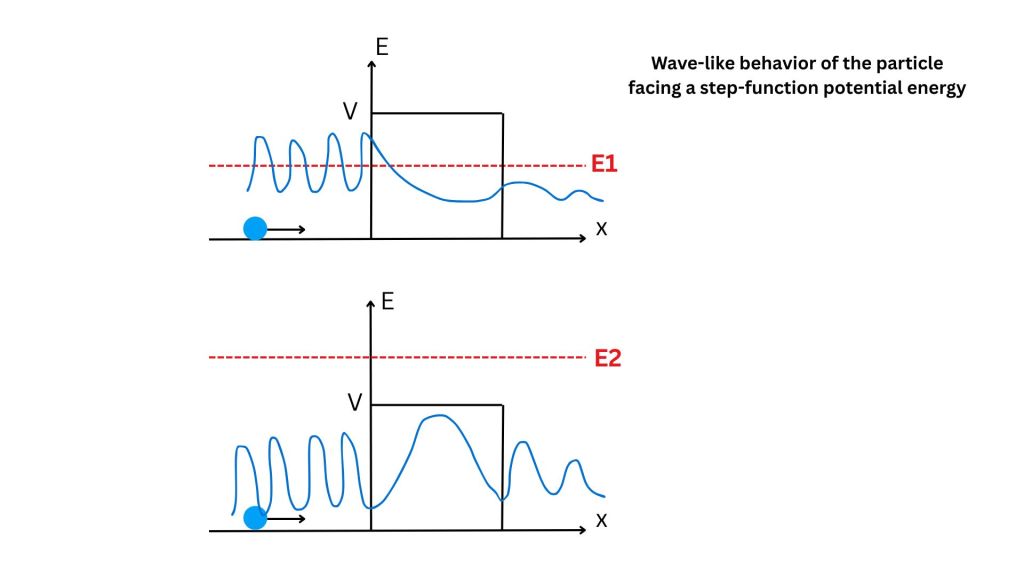
Let’s take the example of a little particle confronting a barrier, namely the potential energy. Let’s assume that at some point, the potential energy of the world, a part that can affect the fate of our particle appearing in front of it, takes the form of a step function. In the classical world, where the conservation law of energy dominates, the particle with intrinsic energy less than the potential energy (E1<V) will be stuck behind the barrier. This wouldn’t be the fate of the particle if it were in an energy level higher than the step potential energy (E2>V). This particle would pass over the barrier without feeling its potential energy. Quantum mechanically, however, the fate of the particle might be different in both situations. Neither the low-energized particle (E1<V) is certainly limited to the space before the barrier, nor the particle with high energy (E2>V) seems to be totally free! There is a probability for the particle in both situations to pass over the barrier of potential energy, just as it is possible to bounce back, even for the particle with a high level of energy. We can say that no particle is completely bound and no particle is completely free. There is no certainty about the state of the particle regardless of its energy level. The energy of the particle only affects the probability, not the outcome directly!
But, wait a minute! What happened to the conservation law of energy? Classically, we know, the particle with low energy is banned from passing over the barrier where it would have a negative kinetic energy! Is negative kinetic energy allowed in the quantum mechanical view of the world?
In a quantum world, it’s not all about energy! The dominating principles are different! It’s all about the wave function, which combines both particle and wave pictures for any material particle. It’s not that the particle emits a wave; it is the wave itself. But being a wave doesn’t disqualify it from being a particle. The quantum particle, and basically any microscopic object, shows this dual behavior, particle and wave, which are mutually exclusive entities in our classical understanding of a material particle! This wavelike behavior of the particle allows it to penetrate into the areas that are classically forbidden. That is to say, the wave evolves in space and time (according to a well-defined mathematical framework), and when it confronts the barrier of the world’s potential energy, its form and maybe its direction of propagation change based on the boundary conditions. A particle with energy lower than the barrier can basically get through it; only its oscillation as a wave will be damped out. Penetrating into the barrier, however, does not mean that the particle will certainly reach the other side; There is another boundary condition, the second wall of the potential barrier, where the particle might be again bounced back just as it was probable on the first boundary! The energy difference, if the particle reaches the other side of the barrier, defines how the resulting wave will look. Even a particle with an initially higher intrinsic energy than the barrier feels the presence of the barrier in the way that its oscillation will be slower (longer wavelength), if it gets through it. Strangely, there is a probability, even for the high-energy particle, that it might be reflected back from the barrier and not make it to the other side! As seen in both graphs, the wave function of the particle displays an oscillatory pattern in all three regions, with an energy (amplitude) reduction every time that the particle faces a new boundary.
This dual picture of particle and wave for describing the same material particle does not exist classically. Being both particle and wave, or to say neither a pure particle nor a pure wave, is a true reality, it is not invented but observed in a double-slit experiment where a particle was allowed to pass through two slits. While it was expected that it would appear in front of one slit, depending on where it chose to go through, an interference pattern was observed, which is a characteristic of a wave, showing that the particle, apparently no longer a particle, passed through both slits! It was tried, by closely observing the particle on each slit, to determine through which slit the particle went. But it turned out that every apparatus that could identify the slit only disturbed the particle and destroyed the interference pattern! What could it mean classically?! When you leave the particle by itself in front of a double slit, it shows a wavelike behavior capable of passing through both slits, but when you try to determine its path by doing any measurement, all you see is a normal particle passing through one of the slits! That’s weird! Surely, the rigid concept of either/or (either a particle or a wave) gets into trouble with this reality! Only the quantum wave function can describe this strange behavior, a wavelike particle with a probability of being found anywhere before its state being measured. Our act of looking at the particle will knock it out of its capacity to display that wave feature!
Apparently, only microscopic particles behave differently from classical particles. However, if any object is made of atoms, it’s not crazy to think all things, including you and me, also obey the rules of quantum mechanics. In fact, macroscopic objects also display wave properties. Only, being very massive, their wavelength is too small and undetectable. Considering a wavy character for the whole world possessing a wave function, just as it’s true for each one of its elements, makes us believe the contrast between the true reality and the portion of reality that we can observe! What happens exactly there, when we try to get close to what is really there! No one really knows, and we leave it to science to further investigate theories or discover new ones. Whatever the outcome, it does not change the fact of living in an uncertain world of endless possibilities ruled by a hidden law of probable outcomes.
* „Something deeply hidden“ by Sean M. Carroll


Leave a Reply