In the life of each one of us, there are some episodes that have the capacity to become a great story. They are, of course, some personal diaries which, depending on the occasions and the way they happened, became our precious or perhaps painful memories. Whether we communicate them or not, they are the highlights of various chapters of our life affecting our personal character and/or our life journey in some way. As time goes by, we might recall them as “experiences” or “lessons” that we took from each chapter. The “turning point experiences”, however, are different; They can strongly affect our future by providing the opportunity for a sudden major change. They are unique moments incorporating different alerting experiences that converge together in one spot where all the powers of the universe want to suddenly take us to a new path. Such moments seldomly happen in our lifetime. Or, it could be that we don’t recognize them simply because we are not alert to our experiences. Without being recognized, no turning point can become a possible beginning of a real change in our life.
How do we define a turning point?
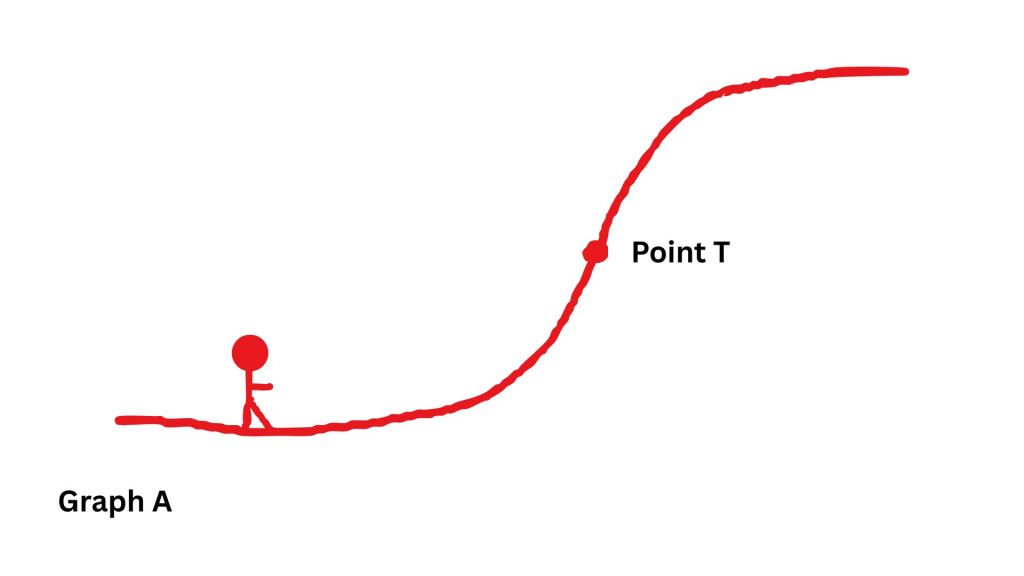
In mathematics, turning points are the points of a graph or function at which the pace (namely the slope) suddenly changes from slowing down to speeding up or vice versa. As you see in graph A, the point T divides the path into two parts; While before this point, the slope is increasing, it suddenly starts to slow down after this point. Now, imagine walking along the path of graph A. You should certainly feel no change in the direction of the route at point T; It’s constantly upwards! This is exactly how the turning point experiences in our life look like, they show no obvious alteration in our direction. Nothing seems to be changing on the surface. Yet, in the hidden unobservable layers of reality, where the physical laws might behave in the way we aren’t used to, something is happening, a preparation for a sudden change.
You might say, “I’m happy with my life, I don’t need a big change!” It might be true, but you should know that the turning point experiences are more than being just happy or successful, whatever “success” might be defined in the eyes of our societies, fame, wealth, or any kind of achievements in some level for our job, family, relationships, and so on. They all might give us a sense of purpose as we set goals and make plans to accomplish them. There is of course nothing wrong about this typical definition of success that nearly most of us have, except that if we don’t achieve our goals, we might feel that we have somehow failed. That is to say, some sort of “gain” and “loss” is always involved in this kind of definition. As a result, we should deal with the feeling of failure as a side effect of losing which is not just about losing some materials like money but also the time, energy, and even dreams and thoughts that we’ve spent to accomplish something. You might think that this feeling of failure is not the side effect of not achieving, rather it should be the result of not trying. Based on this mindset you can still be proud of your efforts even if you don’t achieve your goals. Yes, we all know the famous quote, “the destination is not as important as the journey itself”, and it holds true at some point. Because it is in the process of making your goal that you learn and grow and your character will be developed. But, can we always learn something during the process, something that would diminish the feeling of failure if we don’t achieve our goal? Another word, do all goals worth trying? Without a doubt, we always learn a lesson from our failures, the least of which is to realize that the path we chose was not the right one. However, the weight of loss compared to the gain does also matter. It might be that we put a huge amount of time on a goal until we find out we can’t accomplish it. Is it worth loosing a huge amount of time (and energy and other resources) just to find out that it was not perhaps the right goal for us? The truth is, if we are not careful about our goals, we will be bound in the state of repeating some experiences over and over. That makes our life trajectory like a circle around which we just turn with our eyes fixed on a goal that we put in the center while experiencing the same things without recognizing the critical moments of our life which aim to lead us out of this hamster wheel.
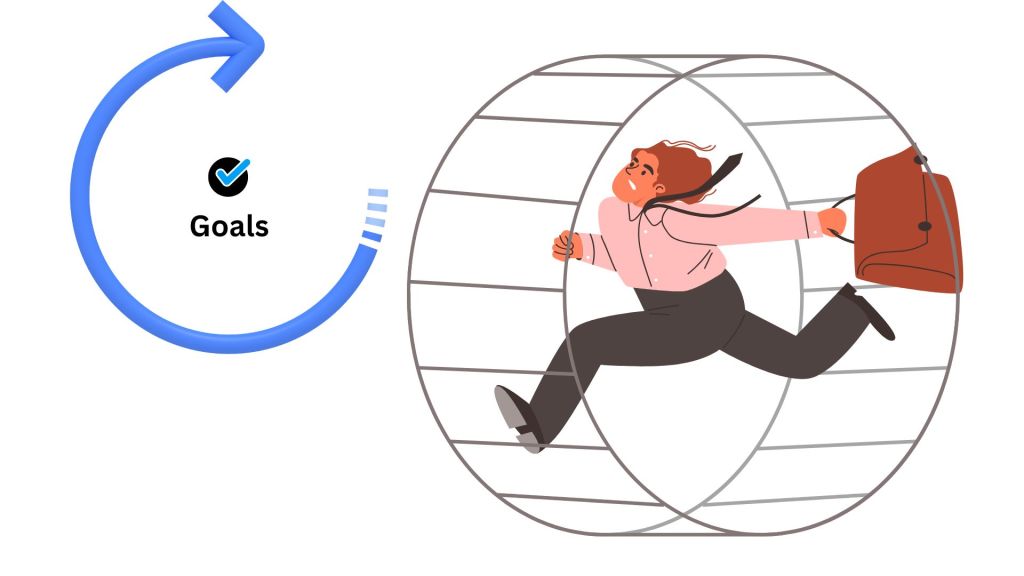
This picture of a hamster wheel-like path around a fixed goal doesn’t mean that setting goals has always a negative impact on our life. However, it does show that our routinely made plans toward a certain goal can distract us from perceiving the life-changing turning points. So, are there right and wrong goals, and how we can distinguish them? Asking these sorts of questions, however, even if we find some convincing answers for them, will get us nowhere. We simply need a new perspective; The new mindset should be heading towards a right path. That is, not looking for the right goals but striving to find the best trajectories for our life. With the right direction, we will be able to live a true version of ourselves, the one who lives a fulfilled life in which all of our potentials come out to the full.
Along a true trajectory, there would be no wrong goal because our ambitions, our thoughts, and even our needs are fully guided by the natural forces of the universe and these universal laws never fail. It doesn’t mean that such trajectories are straightforward routes. They can even have many complicated forms with numerous numbers of up and down. However, by placing ourselves on a true path, we are tuning our energy to the energies that govern all the processes of the world as well as their correlations. It is important to understand that being tuned to the governing energies of the universe does not mean to keep our energy level high! That’s another concept; We hear it often, “being in a good mood or high level of energy makes it easier to overcome the obstacles!” It’s true but also impractical, because it’s impossible to be in a high state of energy all the time. We can sometimes achieve it, for example via meditation, positive thinking, or other practices. Most of the time, however, we don’t even know about which kind of energy we are talking about! Being tuned to the potential energies of the world means to understand how those energies work and train our trine sources of energy, namely our body, our mind, and our spirit, to function based on those rules.


Leave a Reply